You're three weeks from your return date, staring at your pump options while your baby naps, wondering if the one your insurance covers will actually survive a nine-hour workday in an open-plan office. You need something that won't announce itself during a conference call. Something that won't die between the 11am and 2pm sessions. Something that keeps your supply where it needs to be, even though you'll be pumping three times a day instead of ten.
Finding the best breast pumps for working moms isn't the same as finding the best pump, full stop. The office changes the equation completely. Noise, battery life, wearability, suction strength, and insurance eligibility all land differently when you're pumping between meetings instead of on your living room couch. We've been the #1 top choice breast pump brand for 10 years, and we built every pump in our lineup with exactly this situation in mind hospital-grade performance that fits into your real life, covered at $0 through your insurance for most moms .Here's something most new parents don't find out until later: insurance, registries, and manufacturers all offer free items most people never claim. Our free baby stuff for new moms guide breaks down exactly what's available.
Before you scroll — claim the biggest freebie on this list
Your ACA insurance already covers a hospital-grade Hygeia pump. $0 out of pocket. Ships before baby arrives.
✓ Retail $259.99 — you pay $0
✓ 2 minutes. No card. No commitment.
✓ BCBS, Aetna, UHC, Cigna, Humana + 200 more
Join 250,000+ moms who paid $0 with insurance
What Makes a Breast Pump Actually Work at Work
Before the picks, you need a framework. Most roundups hand you a list. We'd rather help you make the decision. Five criteria separate a pump that works in an office from one that works only on your nightstand.
| Criteria | Why It Matters at Work | Target Spec |
|---|---|---|
| Noise Level | Open offices, shared lactation rooms, and Zoom calls make a loud pump a liability. | Under 50 dB |
| Battery Life | You can't count on finding an outlet. 2–3 full sessions per charge is the minimum for a real workday. | 8–10 hrs / 2–3 sessions |
| Wearable In-Bra Design | Fully in-bra pumps let you move and pump hands-free without announcing it. External kits require more privacy. | Fully in-bra, no external kit |
| Suction Strength (mmHg) | Working moms pump 2–3x/day — fewer sessions than stay-at-home moms. Each one has to work harder. | Hospital-grade: 270+ mmHg |
| Insurance Eligibility | Most moms qualify for a $0 pump through ACA coverage. Non-covered pumps mean unnecessary out-of-pocket spend. | ACA-eligible |
That suction point deserves more explanation because most roundups skip it. When you're at home, you're nursing and pumping constantly eight to twelve sessions a day keeps supply steady even if the pump isn't extracting every drop. When you're back at work, you're down to two or three sessions during the workday. Each one needs to work harder. A consumer-grade pump that "does the job" at home starts failing you at week six or eight post-return not because your supply dried up, but because the pump couldn't clear the breast efficiently in limited sessions. Hospital-grade suction isn't just a premium feature. For working moms, it's a supply protection strategy.
Quick answer: What's the best breast pump for working moms?
The Hygeia Esprit is the best overall pick for working moms: fully in-bra wearable, hospital-grade suction, cordless, and quiet enough for open offices. If you're an exclusive pumper who needs maximum suction and a full accessory kit, the Nova Luxe is the stronger fit.

The Best Breast Pumps for Working Moms in 2026
Here's what we actually recommend three Hygeia picks ranked by working-mom fit, plus two honest competitor mentions because you deserve the full picture.
1. Hygeia Esprit — Best Overall for Working Moms
The Esprit earns the top spot because it solves the problem most working moms have: genuine hospital-grade suction in a fully in-bra wearable design. You get the power you need for supply protection and the hands-free discretion you need for the office, and very few pumps on the market actually deliver both. It's cordless, quiet, and ACA-eligible at $0 for most moms. If you can only order one pump before your return date, order this one.
2. Hygeia Fit Pro — Best Budget Hospital-Grade Option
At $174.99 and $0 through most insurance plans, the Fit Pro delivers something the budget category rarely touches: actual hospital-grade suction in a cordless wearable. Dual-phase suction mimics your baby's natural nursing pattern for better let-down and more efficient emptying. If your priority is hospital-grade performance without the flagship price, the Fit Pro is hard to argue with.
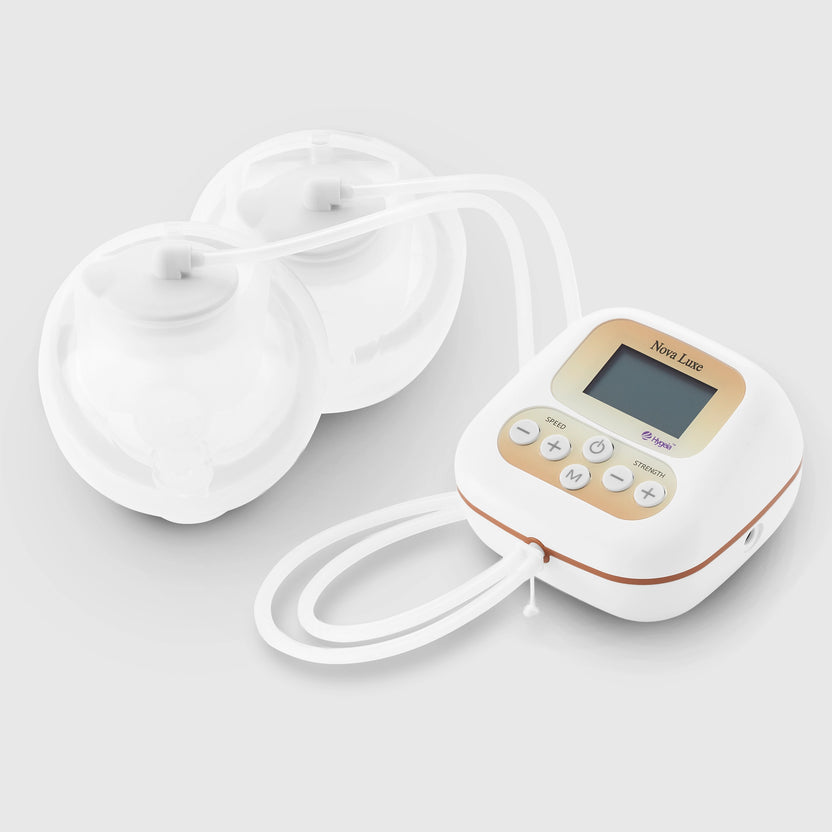
3. Hygeia Nova Luxe — Best for Exclusive Pumpers and Premium Performance
The Nova Luxe is our flagship hospital-grade closed system, rated the top choice electric breast pump for 10 years, in a rechargeable, cordless design. With suction up to 283 mmHg, independent speed and strength controls, and a full Personal Accessory Set included, it's built for moms who pump seriously, whether that's exclusive pumping, supply-building from the start, or long, demanding sessions at home and at the office. With 2,887+ verified reviews at 4.9/5 stars behind it, it's the pump we recommend when one session has to count.
4. Spectra S1 Plus — Honest Honorable Mention

*Avail pumps at $0 as per your state & insurance coverage.
The Spectra S1 is widely recommended by lactation consultants, runs at a quiet 43 dB, and delivers 270 mmHg suction with a rechargeable battery. Solid hospital-grade pump. The trade-off: it's not wearable, so it needs a pumping bra and a private space. Works great if you have a locking office or dedicated lactation room. If you're in an open office or shared space, you'll want a fully in-bra wearable instead.
5. Momcozy M9 — Secondary Pump Mention

*Avail pumps at $0 as per your state & insurance coverage.
The Momcozy M9 is popular and genuinely useful as a secondary on-the-go pump. Consumer-grade suction means it's better at maintaining supply than building it. Don't make it your only pump if you're an exclusive pumper or actively building supply.
Here's a quick side-by-side for the picks above:
| Pump | Type | Suction | Noise | Battery | Insurance | Best For |
|---|---|---|---|---|---|---|
| Hygeia Esprit | Wearable in-bra | Hospital-grade | <50 dB | Cordless | Yes - $0 | Best overall for working moms |
| Hygeia Fit Pro | Wearable cordless | Hospital-grade | Quiet | Rechargeable | Yes - $0 | Budget hospital-grade pick |
| Hygeia Nova Luxe | Cordless closed system | Hospital-grade | Quiet | Rechargeable | Yes - $0 | Premium home + office use |
| Spectra S1 Plus | Traditional electric | 270 mmHg | ~43 dB | Rechargeable | Yes - many plans | Private office with outlet |
| Momcozy M9 | Wearable in-bra | Consumer-grade | <50 dB | Good | Varies | Secondary on-the-go pump |
Why Mothers and Experts Trust Hygeia
Celebrated by leading parenting and health organizations for innovation, efficiency, and mom-approved design.

Parents Pick Award
"Hospital-grade, cordless, hands-free pump designed for ultimate convenience and efficiency."

Mom's Choice Award
"It's cordless, rechargeable design lets you pump anytime, anywhere."

The Bump
"Best hospital-grade breast pump"
Baby Maternity
"In my humble but experienced opinion, the comparable pumps don't really compare."

The leaky Boob
"In my humble but experienced opinion, the comparable pumps don't really compare."
When to Use a Wearable Pump vs. a Traditional Pump at Work
This is the question every working mom lands on eventually. Here's how to think through it based on your actual work setup:
- Open office or shared lactation room, no dedicated outlet: A fully in-bra wearable pump is non-negotiable. Discretion and battery independence matter most here.
- Private office with a locking door and outlet: A traditional hospital-grade pump works well. You get stronger output from the direct power source and full privacy.
- Hybrid schedule: The two-pump approach works best wearable hospital-grade for office days, traditional for home morning and evening power sessions.
- Exclusive pumper or actively building supply: Hospital-grade suction is non-negotiable regardless of form factor. Get a wearable that delivers hospital-grade performance, like the Hygeia Esprit.
One thing to check before committing to any pump: flange fit. Poor flange sizing causes pain, reduces per-session output, and accelerates supply drops especially when pumping in rushed 20-minute blocks. Our flange sizing guide walks you through exactly how to measure.
Your Legal Rights as a Pumping Employee in 2026
This section matters more than most working moms realize, because most working moms don't know they have these rights. A 2025 Mamava and Medela survey of nearly 3,000 breastfeeding parents found that only 55% understood their legal protections under the PUMP Act, which is exactly the gap this section is here to close.
Under the PUMP for Nursing Mothers Act, signed into law in December 2022, all employees covered by the Fair Labor Standards Act have the right to reasonable break time and a private, non-bathroom space to pump for one year after giving birth. That includes salaried workers, teachers, nurses, agricultural workers, and retail employees. Employers of all sizes must comply. The space must be shielded from view, free from intrusion, and cannot be a bathroom even a private one. (A narrow group, rail and motorcoach transportation workers, only became covered as of December 2025, after a compliance delay.)
If your employer doesn't comply, they have 10 days to fix it once you notify them. After that, you can file a lawsuit. Many states offer even stronger protections search "pump at work rights [your state]" to see what applies to you.
How to Set Up Your Pumping Schedule at Work
Talk to HR before your first day back. Identify your pumping space, block your sessions on your calendar so they hold reliably, and set phone reminders.
- Under 6 months: pump every 2–3 hours typically 2–3 sessions across an 8-hour workday.
- Over 6 months: every 3–4 hours is usually sufficient as supply regulates.
- Track every session: the free Hygeia Baby app logs sessions automatically and helps you spot supply trends before they become problems.
What Happens to Your Milk Supply When You Return to Work
A slight supply dip in the first one to two weeks back is normal. It doesn't mean you're failing. It doesn't mean you have to stop breastfeeding.
Your body has been regulating supply around constant access to your baby. The sudden shift to scheduled pumping, new stress levels, less rest, and unfamiliar environments all affect let-down and output in the short term. Most moms see output stabilize within two weeks once the pumping schedule becomes consistent and the body adjusts.
Here's what actually helps:
- Consistent schedule. Pump at the same times each day. Consistency is the single biggest lever for supply stability.
- Hospital-grade suction. Each session needs to actually empty the breast. Lower-powered pumps don't compensate for fewer sessions they lead to slower clearance and gradual supply decline.
- Hydration. 80–100 oz of water per day is the real target for pumping moms. Keep a large water bottle at your desk.
- IBCLC support when you need it. If output doesn't recover after two weeks, don't wait. We partner with Nest Collaborative for virtual IBCLC-led lactation consultations often covered by insurance. Book a session at hygeiahealth.com/pages/lactation-assistance.
For reference on what output benchmarks look like at different stages, our normal pumping output guide breaks down what's typical at 6 weeks, 3 months, and 6 months postpartum.
How to Get Your Breast Pump Covered by Insurance
Under the Affordable Care Act, most insurance plans must cover a breast pump per pregnancy at no cost to you. All three Hygeia pumps, the Esprit, Nova Luxe, and Fit Pro, are ACA-eligible. Here's how to get it sorted before your return date:
- Check your eligibility. Go to hygeiahealth.com/pages/insurance and enter your insurance details.
- Submit your insurance form. Fill out the form at hygeiahealth.com/pages/insurance-form. Our team verifies your coverage and confirms which Hygeia pumps your plan covers.
- Receive your pump before your return date. Order around week 28–30 of pregnancy so you have time to practice. Most plans ship directly to your door.
FSA and HSA funds also cover any breast pump if your plan doesn't cover your preferred model. Our team verifies your specific plan, so you know exactly what you're getting before you order.
Insurance Plans We Work With


How to Claim Your Free Breast Pump
Complete our online insurance verification form. You will need your insurance card.
Choose your Hygeia pump from the options covered under your plan.
We handle the paperwork, verify your prescription and deliver your breast pump.
Most plans allow you to order starting at 30 weeks gestation. Order 30 to 60 days before your due date so the pump is ready before baby arrives. Check your full insurance coverage here. You can also check what free baby stuff you will get through Medicaid.
Frequently Asked Questions
What is the best breast pump for working moms in 2026?
The Hygeia Esprit ranks as our top choice for working moms in 2026. It delivers hospital-grade suction in a fully in-bra wearable design, runs cordless, and operates quietly enough for open offices and video calls. The Hygeia Nova Luxe is the better pick for exclusive pumpers who need a higher-volume setup with a full Personal Accessory Set included.
Do I need a wearable pump to pump at work?
A wearable in-bra pump is the most practical choice for open offices and shared lactation rooms, but it's not the only option. If you have a private office with a locking door and outlet access, a traditional hospital-grade pump works well and often delivers stronger output. The right choice depends on your work environment.
Can I pump at work legally?
Yes. The PUMP for Nursing Mothers Act signed into federal law in December 2022 requires all FLSA-covered employers to provide reasonable break time and a private, non-bathroom space to pump for one year after birth. This applies to salaried employees, teachers, nurses, agricultural workers, and most other categories. Your employer cannot legally deny you time and space to pump.
Will my milk supply drop when I return to work?
A slight dip in the first one to two weeks back is common and usually corrects with a consistent pumping schedule and proper hydration. Using a hospital-grade pump ensures each of your 2–3 daily work sessions empties the breast efficiently. If output doesn't recover after two weeks, an IBCLC lactation consultant can help we partner with Nest Collaborative for virtual sessions that many insurance plans cover.
Are breast pumps covered by insurance for working moms?
Yes. The Affordable Care Act requires most health insurance plans to cover a breast pump per pregnancy at no cost to the patient. All Hygeia pumps, Esprit, Nova Luxe, and Fit Pro, are ACA-eligible. Check your eligibility at hygeiahealth.com/pages/insurance or submit the insurance form to get started before your return date.
How often should I pump at work?
Most lactation consultants recommend pumping every 2–3 hours for babies under 6 months, or every 3–4 hours for babies over 6 months. For a standard 8-hour workday, that means 2–3 sessions. Consistency matters more than exact timing pumping at roughly the same times each day helps your body regulate supply and keeps let-down predictable.
What features matter most in a breast pump for work?
Prioritize noise level under 50 dB, battery coverage for 2–3 sessions without charging, a fully in-bra wearable design, and hospital-grade suction of 270+ mmHg. Insurance eligibility also changes the math entirely a $239.99 hospital-grade pump at $0 through your plan means the cost barrier disappears entirely.
What is a double electric breast pump, and is it better for working moms?
A double electric breast pump pumps both breasts at the same time instead of one at a time, cutting your session length roughly in half. For working moms squeezed into 2 to 3 sessions a day instead of nursing on demand, that efficiency matters. The Hygeia Fit Pro and Nova Luxe are both double electric pumps, so you get full output in less time between meetings.
How do I stay comfortable pumping during a long workday?
Correct flange fit matters more than the pump itself. A flange that's too tight or too loose causes pain and reduces output, which gets worse the longer you're wearing it during a rushed session. Check your fit with our flange sizing guide, and choose a lightweight, fully in-bra wearable pump so you're not held in one position at your desk for the whole session.
Is a hospital-grade pump the same as a professional breast pump?
Yes, these terms are generally used interchangeably. A hospital-grade or professional-grade pump is built with a stronger motor and closed system designed for frequent, multi-user use in clinical settings, which translates to more consistent, reliable suction for personal use too. All Hygeia pumps use hospital-grade motors, even in their personal, single-user wearable designs.
Get Your Pump Sorted Before Your First Day Back
Returning to work while breastfeeding takes planning. Your pump shouldn't be one more thing to figure out the week before you go back. The moms we hear from most often say the same thing: they wish they'd checked their insurance earlier, ordered sooner, and had more time to practice with the pump before that first workday. Don't let that be you. Also read our guide to know more about what are the freebies you would get.
Check your insurance eligibility today at hygeiahealth.com/pages/insurance. Most moms qualify for a hospital-grade Hygeia pump at $0 and our team verifies your specific plan so there are no surprises. If you want IBCLC support for your return-to-work transition, book a virtual lactation consultation through Nest Collaborative at hygeiahealth.com/pages/lactation-assistance. You deserve to walk back into that office prepared. Moms deserve more.