One of the most practical questions every pumping mom asks right from the very first session is: how often should you pump breast milk? It seems like it should have a simple answer. But the reality is that the right pumping frequency depends on your baby's age, your personal supply goals, whether you are nursing, working, or exclusively pumping, and how established your supply currently is.
Get the frequency right and your supply stays strong, your baby has plenty to eat, and you avoid the discomfort of engorgement. Get it wrong and you risk a supply dip that can be difficult to recover from. At Hygeia Health, we want to take the guesswork out of this entirely. This guide covers exactly how often should I pump breast milk at every stage from the newborn days through returning to work, exclusive pumping, and beyond.
Before you scroll — claim the biggest freebie on this list
Your ACA insurance already covers a hospital-grade Hygeia pump. $0 out of pocket. Ships before baby arrives.
✓ Retail $259.99 — you pay $0
✓ 2 minutes. No card. No commitment.
✓ BCBS, Aetna, UHC, Cigna, Humana + 200 more
Join 250,000+ moms who paid $0 with insurance
The Core Principle: Match Your Baby's Feeding Rhythm
Before getting into the specific numbers, understanding the principle behind them makes the guidance much easier to follow and adapt. Your breast milk supply is driven entirely by demand. The more often your breasts are emptied whether by your baby nursing or by your pump the more milk your body produces. The less often they are emptied, the less milk your body makes.
This means that, in general, your pumping frequency should mirror the frequency at which your baby feeds at that stage of development. A newborn feeds 8 to 12 times per 24 hours. A 6-month-old feeds 5 to 8 times. As your baby's feeding patterns evolve, your pumping schedule can evolve with them. Keep this principle as your anchor, and the stage-by-stage guidance below will make immediate sense.
How Often Should You Pump Breast Milk by Stage
Stage 1: Newborn (0–4 Weeks) Establishing Supply
The newborn stage is the most critical window for establishing your long-term milk supply. This is when your body is calibrating how much milk to produce, and the signals you send now have a lasting impact. For exclusively pumping moms, aim for 8 to 12 pumping sessions per 24 hours roughly one session every 2 to 3 hours. For nursing moms who are also pumping, pump after each nursing session to drain the breast fully and signal maximum production.
- Do not go more than 4 to 5 hours without pumping even overnight in the first two to three weeks.
- If your baby is in the NICU or unable to nurse, begin pumping within 1 to 6 hours of birth if possible, and pump every 2 to 3 hours from there to signal production.
- Session duration: 15 to 20 minutes per session, or until milk stops flowing and 1 to 2 minutes beyond.
- Do not be alarmed by small quantities in the first few days colostrum is produced in small but highly concentrated amounts and is exactly what your newborn needs.
Stage 2: 1–3 Months Building and Regulating
By 1 to 3 months, your supply begins to regulate and becomes less driven by hormonal fluctuation and more responsive to consistent demand patterns. If you are exclusively pumping, maintain 7 to 9 sessions per 24 hours. If you are nursing and pumping, you can often reduce to pumping 2 to 3 times per day, focused on building your freezer stash or supplementing feeds.
- Most moms can gradually begin dropping the overnight pumping session around 8 to 12 weeks, though this should be done slowly to avoid engorgement or supply dips.
- If your supply is still being established, maintain higher frequency through this stage.
- Morning sessions (first pump of the day) typically yield the most milk schedule your most important session here.
Stage 3: 3–6 Months Settled Routine
By 3 months, most moms have a well-established supply and a more predictable feeding or pumping routine. Exclusively pumping moms often settle into 6 to 8 sessions per 24 hours. Nursing moms pumping to supplement may pump 1 to 2 times daily. Your output per session may actually increase at this stage as your supply has had time to mature and your pump technique has improved.
Stage 4: Returning to Work (Typically 6–12 Weeks Postpartum)
Returning to work is one of the most common triggers for supply dips among pumping moms and almost always, the cause is a reduction in pumping frequency during work hours. When you return to work, pump as often as your baby would normally feed: every 2 to 3 hours, or a minimum of 3 times during an 8-hour workday.
- Stick to consistent pump break times each day irregular timing can affect supply regulation.
- Pump first thing in the morning before leaving home, and immediately when you return in the evening.
- Use a wearable, hands-free pump like the Hygeia Esprit or Hygeia Novo Luxe to pump during calls or at your desk without disrupting your workday.
- In the US, federal law (PUMP Act) requires employers to provide reasonable break time and a private space for nursing employees to pump.
For a detailed plan, our complete guide on pumping at work covers everything from scheduling to storage at the office.
Exclusive Pumping: How Often Is Enough?
If you are exclusively pumping meaning your baby receives all breast milk through a bottle rather than nursing your pump is fully standing in for your baby's feeding cues. This makes pumping frequency especially important, since there is no baby at the breast to signal production between sessions.
General guidelines for exclusive pumpers:
- 0–12 weeks: 8 to 12 sessions per 24 hours
- 3–6 months: 6 to 8 sessions per 24 hours
- 6–12 months: 5 to 6 sessions per 24 hours as solids are introduced
- 12+ months: Gradually reduce based on how much breast milk you wish to continue providing
The most important rule for exclusive pumpers: do not drop sessions too quickly. Each session dropped should be reduced gradually extend the interval between two sessions by 30 minutes per day over a week rather than eliminating a session abruptly. Abrupt reductions in frequency are one of the fastest ways to tank supply.
For a deep-dive into the exclusive pumping journey, visit our comprehensive guide on breast milk mastery: pumping, storing, thawing, and feeding.
How Long Should Each Pumping Session Last?
Session duration matters as much as frequency. The goal of every pumping session is to completely empty the breast. Incomplete emptying stopping too early because output has slowed leaves milk behind and signals your body to produce less next time.
- Standard duration: 15 to 20 minutes per session for most moms.
- Minimum rule: Pump for at least 2 minutes past the last visible drop of milk.
- If supply is low: Extend sessions to 25 to 30 minutes and add breast massage during the session to improve emptying.
- If output is very fast: Some moms with high supply empty fully in 8 to 12 minutes this is normal, and stopping when milk stops is perfectly fine.
Do You Need to Pump at Night?
This is one of the questions that comes up most often understandably, since sleep is precious in the early months. The answer depends on your stage and supply status.
In the first 8 to 12 weeks: Yes. Prolactin levels peak between 1 AM and 5 AM, making nighttime sessions particularly effective for establishing and protecting your supply. Skipping all nighttime pumping during this window frequently leads to supply dips that are hard to recover from.
After 12 weeks: Many moms can gradually reduce or eliminate the overnight session once supply is well established. Do this slowly extend your overnight break by 30 minutes every few days rather than dropping it all at once. Watch your output at the first morning session as an indicator of whether supply is being affected.
If your supply is low or your baby is premature: Maintain nighttime sessions longer, guided by your lactation consultant or healthcare provider.
Signs You Are Pumping Too Infrequently
If you are not pumping frequently enough, your body will give you clear signals. Watch for these signs that it is time to add sessions back:
- Noticeable decline in output per session over several consecutive days
- Breasts no longer feeling full or engorged between sessions
- Baby seeming unsatisfied after bottles, or needing larger volumes than expected
- Painful engorgement if sessions are too far apart
- Milk taking longer to let down during sessions
If you notice any of these, increasing frequency for a week or adding a power pumping session daily is usually enough to restore supply. For more guidance on what normal output looks like at each stage, visit our resource on normal pumping output amounts.
Choosing a Pump That Keeps Up With Your Schedule
When you are pumping 8 or more times per day, your pump is not just an accessory it is a critical piece of equipment that affects your supply, your comfort, and your time. A pump that is slow, loud, or uncomfortable makes it harder to maintain the frequency your supply needs.
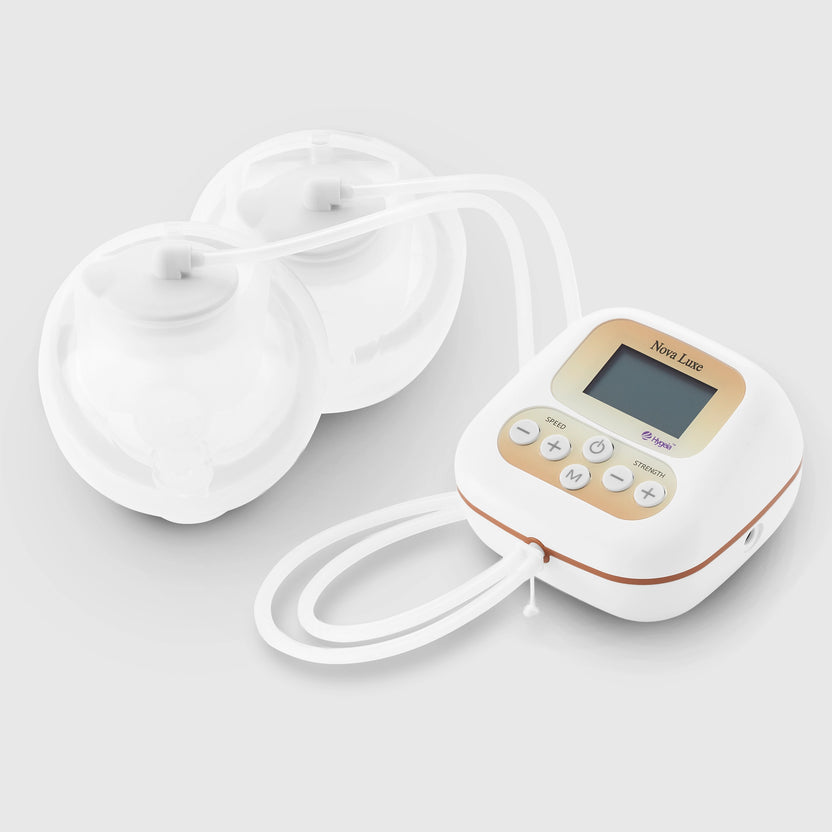
All Hygeia pumps are engineered to perform at hospital-grade standards across the full range of daily sessions. The Hygeia Nova Luxe offers customizable suction and cycle settings for both letdown and expression phases, rated the top choice pump for over 10 consecutive years. The cordless, wearable Hygeia Esprit allows you to pump anywhere at your desk, during a commute, or while managing household tasks making it much easier to stay on your pumping schedule throughout the day.
Why Mothers and Experts Trust Hygeia
Celebrated by leading parenting and health organizations for innovation, efficiency, and mom-approved design.

Parents Pick Award
"Hospital-grade, cordless, hands-free pump designed for ultimate convenience and efficiency."

Mom's Choice Award
"It's cordless, rechargeable design lets you pump anytime, anywhere."

The Bump
"Best hospital-grade breast pump"

Baby Maternity
"In my humble but experienced opinion, the comparable pumps don't really compare."

The leaky Boob
"In my humble but experienced opinion, the comparable pumps don't really compare."
All Hygeia personal-use pumps are insurance-eligible at $0 out of pocket under the ACA mandate. Get your free breast pump through insurance
Insurance Plans We Work With


How to Claim Your Free Breast Pump
Complete our online insurance verification form. You will need your insurance card.
Choose your Hygeia pump from the options covered under your plan.
We handle the paperwork, verify your prescription and deliver your breast pump.
Most plans allow you to order starting at 30 weeks gestation. Order 30 to 60 days before your due date so the pump is ready before baby arrives. Check your full insurance coverage here. You can also check what free baby stuff you will get through Medicaid.
Frequently Asked Questions
How often should you pump breast milk to maintain supply?
To maintain supply, pump as often as your baby feeds at their current stage typically 8 to 12 times per 24 hours in the newborn stage, reducing gradually to 5 to 8 times as baby grows. The key rule: do not go more than 4 to 5 hours without pumping or nursing in the early months.
How often should I pump breast milk as a newborn mom?
In the newborn stage (0 to 4 weeks), aim for 8 to 12 sessions per 24 hours roughly every 2 to 3 hours. This frequency establishes the supply baseline your body will regulate around for the coming months.
How often should I pump when I return to work?
Pump as often as your baby would feed at minimum 3 times during an 8-hour workday, ideally every 2 to 3 hours. Skipping sessions at work is the most common cause of supply dips in the early return-to-work weeks.
Can I pump every hour to increase my milk supply?
Yes , this is called power pumping and is an effective short-term strategy. Do it for 3 to 7 days, then return to your regular schedule. It is not meant to be a permanent approach.
Do I need to pump at night to maintain my milk supply?
In the first 8 to 12 weeks, yes nighttime prolactin peaks make these sessions important for supply establishment. After 12 weeks with a stable supply, many moms can gradually drop the overnight session.
What happens if I pump too infrequently?
Infrequent pumping signals your body to reduce production and can cause engorgement, plugged ducts, and mastitis. If you notice declining output or your breasts not feeling full between sessions, add a session back immediately.
How long should each pumping session last?
Most sessions last 15 to 20 minutes. Pump until milk stops flowing and then for 2 more minutes to ensure full emptying. Full emptying is what triggers your body to produce more milk for next time.
How often should I pump if I am combo feeding?
If nursing and pumping, 2 to 3 daily pumping sessions is typically enough to maintain supply and build a stash. If supply needs a boost, add a session after each nursing feed for a week or two.
Consistency Is the Key to a Strong Supply
The answer to how often should you pump breast milk is not one universal number it is a guideline that evolves with your baby, your lifestyle, and your supply. What stays constant across every stage is the importance of consistency. Regular, complete breast emptying is the single most reliable way to protect and grow your milk supply over time.
Whether you are newly postpartum and building supply from scratch, returning to work and fighting to maintain it, or exclusively pumping and managing every session with precision — Hygeia Health is here to support every step. Our hospital-grade pumps are designed for the rigors of frequent daily use, and our lactation support resources are available whenever you need guidance.
You are doing something remarkable. Moms deserve more — and so does every session you show up for.